
Since their introduction by Dr Arnold Kegel in the 1940’s, Kegel exercises have been considered the go-to solution for pelvic health issues. Thanks to our Grandmother’s words of wisdom, and more recently Instagram and TikTok, I am pleased to say most of us have heard of them, and a lot of us practice them. But in case you’ve missed this trend, a Kegel ‘simply’ involves contracting and relaxing the pelvic floor, the essential hammock of muscles that sit within our pelvis, and support the bowel, bladder and sexual organs. But how do we know we’re doing them right, and what comes next?
Kegel exercises are vital for our pelvic health, and when carried out with the correct technique, can provide some powerful outcomes:
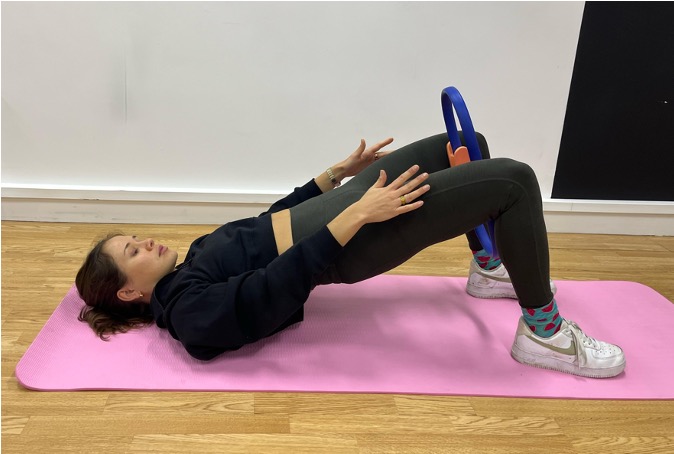
We have Dr Arnold a lot to thank for. However, just like any other rehab plan, exercises should be varied, progressive and individualised in order to optimise the outcome. After all, why should our glute workout progress with load, intensity, frequency, but not our pelvic floor?! More recent research in the area has demonstrated the effectiveness of functional full body exercises in activating the pelvic floor. For example, a glute bridge can achieve 56% more activation than a standard Kegel, when completed in line with the appropriate cues for the breath and pelvic floor.
Recent research has revealed that many women perform Kegels incorrectly, not only negating their benefits but sometimes leading to additional symptoms:
So before cracking on with your 50 Kegels a day, it would be worth considering a pelvic floor assessment, where a specialised practitioner can assess and ‘coach’ or refine your technique. We can give you the tips to work smart not hard and progress your rehab beyond Kegels to get you back to the sports or activities you love, symptom free.
For more information, please read our upcoming blog on ‘Pelvic Floor Assessments: What, When & Why’. Or contact our clinic on 020 3515 2347.
Written by Matilda Wilkinson, MSc Physiotherapist, Pelvic Health & Rehab Specialist based at Maria Elliott’s Physiotherapy Services
Connect with us!
Lets get started
We and our partners, including Google, use cookies and personal data to analyse traffic and for ads personalisation and measurement. You can accept, reject or choose which cookies to allow. Privacy Policy • Cookie Policy • Terms & Conditions • Google Privacy
We use cookies to help you navigate efficiently and perform certain functions. You can choose which categories to allow below. Cookies categorised as Necessary are always active.
We also use third-party cookies for analytics and advertising. These are only stored with your consent. You can update or withdraw consent at any time via the cookie icon at the bottom-left. This site operates under UK GDPR, the Data Protection Act 2018, and the Privacy and Electronic Communications Regulations (PECR). Cookie Policy • Privacy Policy
Necessary cookies are required for core site features including security, network management, and consent storage.
| Cookie | Duration | Description |
|---|---|---|
hmdg_cookie_consent | 180 days | Stores your cookie consent preferences. |
PHPSESSID | Session | WordPress session identifier. |
wordpress_logged_in_* | Session | WordPress login authentication. |
Functional cookies enable enhanced features such as live chat and remembering preferences.
| Cookie | Duration | Description |
|---|---|---|
wp-settings-* | 1 year | Stores user interface preferences. |
Analytics cookies help us understand visitor behaviour. Controls analytics_storage for Google Analytics 4.
| Cookie | Duration | Description |
|---|---|---|
_ga | 2 years | Google Analytics — distinguishes users. |
_ga_* | 2 years | Google Analytics 4 — session persistence. |
_gid | 24 hours | Google Analytics — distinguishes users. |
_gat | 1 minute | Google Analytics — throttles request rate. |
Performance cookies collect aggregate, anonymous data about site performance.
| Cookie | Duration | Description |
|---|---|---|
_gat_gtag_* | 1 minute | Google Tag Manager — rate throttle. |
Marketing cookies track visits to deliver relevant ads. Controls ad_storage, ad_user_data, and ad_personalization.
| Cookie | Duration | Description |
|---|---|---|
_gcl_au | 90 days | Google Ads — conversion tracking. |
_gcl_aw | 90 days | Google Ads — click attribution. |
_gac_* | 90 days | Google Ads — campaign information. |
IDE | 1 year | Google DoubleClick — ad targeting. |
Powered by HMDG • Cookie Policy