
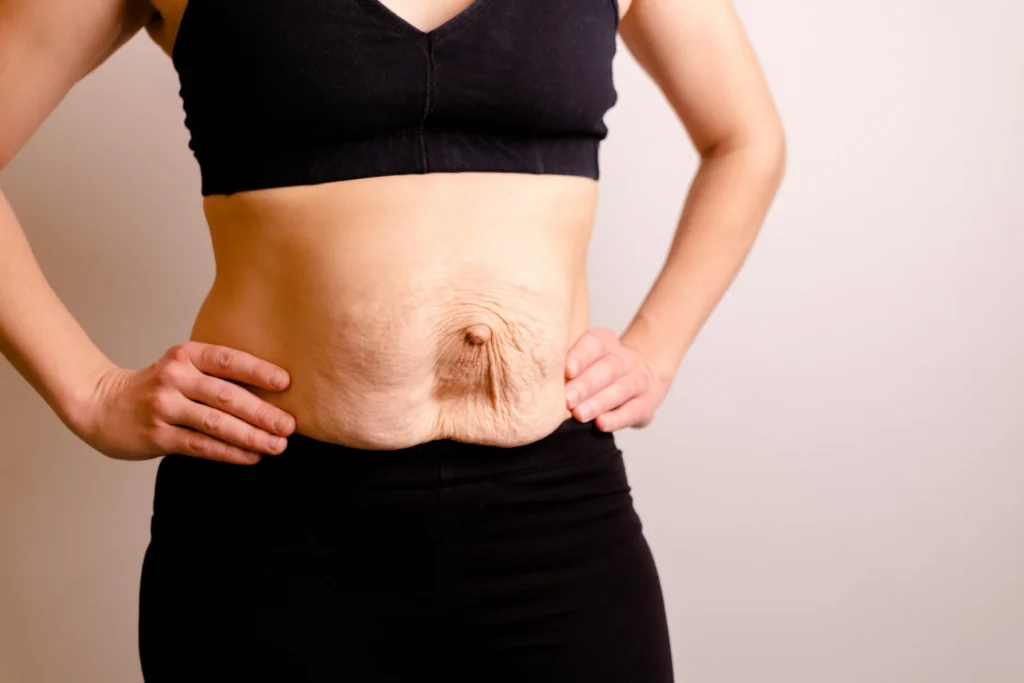
Diastasis recti, often referred to as abdominal separation, is a common change during pregnancy and after childbirth. Many women notice a gap or bulging along the centre of the abdomen, particularly when sitting up or during effort.
At The Pelvic Health Studio in Marylebone, we provide specialist physiotherapy to assess and support recovery from diastasis recti. Our focus is on restoring strength, improving core support and helping you feel confident in how your body moves.
This is not simply about closing a gap. It is about improving how your abdominal wall functions, supporting your posture and helping you return to daily activities and exercise safely.
Diastasis recti is the widening of the connective tissue between the two sides of the abdominal muscles, known as the linea alba.
During pregnancy, this tissue stretches to allow space for the growing baby. This is a natural and expected change. After birth, the body begins to recover, but in some cases the tissue remains more stretched or less supportive.
The key factor is not only the width of the gap, but the tension and strength of the abdominal wall. A smaller gap with poor tension may feel weak, while a wider gap with good support may function well.
Physiotherapy focuses on restoring the strength and coordination of the deep core muscles to improve overall function.
Diastasis recti is most commonly associated with pregnancy and postnatal recovery.
You may benefit from specialist assessment if you:
Assessment can be helpful at any stage, whether you are newly postnatal or several years after pregnancy.
At our Marylebone clinic, we commonly support women experiencing:
Diastasis recti may also be linked to pelvic floor dysfunction, posture changes and breathing patterns.
Your appointment begins with a detailed discussion about your pregnancy, birth and recovery experience, as well as your current symptoms and goals.
Your assessment may include:
The aim is to understand how your abdominal wall is functioning, not just the size of the separation.
Following this, your physiotherapist will explain the findings and create a personalised rehabilitation plan.
Specialist physiotherapy for diastasis recti focuses on improving function and support rather than appearance alone.
Treatment may help you:
With the right guidance, many women feel stronger and more supported within their body.
The Pelvic Health Studio in Marylebone specialises in postnatal recovery and abdominal rehabilitation.
Patients choose us because:
We understand the physical and emotional aspects of postnatal recovery and aim to support you throughout the process.
Recovery from diastasis recti varies depending on factors such as tissue quality, previous pregnancies, activity levels and how the body moves.
Some women notice improvements in awareness and control within a few sessions. Others progress gradually as strength and coordination improve over time.
Rehabilitation focuses on building strength in a progressive and controlled way. Your programme will evolve as your body adapts, helping you return to activity safely.
The goal is to create a stronger, more supportive abdominal wall that functions well in everyday life.
Not always. The focus is on improving function and strength, which is often more important than the size of the gap.
Yes, but exercises may need to be adapted. We can guide you on safe options.
Many women attend after their early postnatal recovery, but it can be assessed at any stage.
No. Many people benefit from rehabilitation even long after pregnancy.
If you are concerned about abdominal separation or feel your core has not recovered after pregnancy, specialist assessment can help you understand what is happening and how to improve it.
At The Pelvic Health Studio in Marylebone, we provide personalised physiotherapy designed to restore strength, support and confidence.
Book your appointment today and take the next step in your recovery.
Connect with us!
Lets get started
We and our partners, including Google, use cookies and personal data to analyse traffic and for ads personalisation and measurement. You can accept, reject or choose which cookies to allow. Privacy Policy • Cookie Policy • Terms & Conditions • Google Privacy
We use cookies to help you navigate efficiently and perform certain functions. You can choose which categories to allow below. Cookies categorised as Necessary are always active.
We also use third-party cookies for analytics and advertising. These are only stored with your consent. You can update or withdraw consent at any time via the cookie icon at the bottom-left. This site operates under UK GDPR, the Data Protection Act 2018, and the Privacy and Electronic Communications Regulations (PECR). Cookie Policy • Privacy Policy
Necessary cookies are required for core site features including security, network management, and consent storage.
| Cookie | Duration | Description |
|---|---|---|
hmdg_cookie_consent | 180 days | Stores your cookie consent preferences. |
PHPSESSID | Session | WordPress session identifier. |
wordpress_logged_in_* | Session | WordPress login authentication. |
Functional cookies enable enhanced features such as live chat and remembering preferences.
| Cookie | Duration | Description |
|---|---|---|
wp-settings-* | 1 year | Stores user interface preferences. |
Analytics cookies help us understand visitor behaviour. Controls analytics_storage for Google Analytics 4.
| Cookie | Duration | Description |
|---|---|---|
_ga | 2 years | Google Analytics — distinguishes users. |
_ga_* | 2 years | Google Analytics 4 — session persistence. |
_gid | 24 hours | Google Analytics — distinguishes users. |
_gat | 1 minute | Google Analytics — throttles request rate. |
Performance cookies collect aggregate, anonymous data about site performance.
| Cookie | Duration | Description |
|---|---|---|
_gat_gtag_* | 1 minute | Google Tag Manager — rate throttle. |
Marketing cookies track visits to deliver relevant ads. Controls ad_storage, ad_user_data, and ad_personalization.
| Cookie | Duration | Description |
|---|---|---|
_gcl_au | 90 days | Google Ads — conversion tracking. |
_gcl_aw | 90 days | Google Ads — click attribution. |
_gac_* | 90 days | Google Ads — campaign information. |
IDE | 1 year | Google DoubleClick — ad targeting. |
Powered by HMDG • Cookie Policy